Training Staff to Recognize and Respect Assent in Learners with Disabilities
Many learners with disabilities cannot give legal consent, but they still communicate “yes” and “no” through words, body language, and behavior. When staff miss these signals, teaching can become something a learner endures rather than participates in—raising stress, eroding trust, and increasing problem behavior. This study offers a practical framework for training staff to notice assent, respond to withdrawal, and adjust instruction in real time.
What Is the Research Question Being Asked and Why Does It Matter?
The researchers asked: Can we train instructors to notice when a student is willing to participate in teaching—and to stop or change course when the student signals they want to stop?
This matters because assent is more than a value statement. It’s a set of observable staff behaviors you can define, teach, and measure.
The study focused on two things staff can control in the moment. First, do they check for assent not just at the start, but during teaching? Second, when the student signals “stop,” does the staff member actually change what they’re doing?
Assent is hard to define and looks different across learners. Some show it by walking to the table, smiling, or orienting to materials. Others show withdrawal by turning away, trying to leave, crying, or engaging in aggression or self-injury. Without clear definitions for each learner, staff will guess—and responses will be inconsistent.
What Did the Researchers Do to Answer That Question?
The researchers worked in two public school classrooms for students with multiple disabilities. Three staff members each worked with one student during 1:1 discrete trial teaching. The team measured staff behavior at baseline, trained staff, measured again, and followed up with maintenance checks.
Training used behavioral skills training (BST): teaching the concept, modeling, role play, and feedback until staff met mastery criteria. Staff also completed a detailed questionnaire to identify each learner’s unique signs of assent and withdrawal. The team selected a small set of assent indicators and a larger set of withdrawal indicators for each learner.
The teaching plan used simple visuals so students could communicate “start,” “stop,” “play,” or “pause.” Staff learned to ask if the student was ready, prompt use of the visual, and keep visuals within reach. When withdrawal occurred, staff were trained to pause or stop, prompt a clear communication response if needed, give access to what the learner requested, and then problem-solve whether the issue seemed like low motivation or task difficulty.
Staff then adjusted instruction—reducing demands, changing tasks, offering more choices, modifying help or error correction, shortening the session, or re-pairing.
The main outcomes were how often staff checked assent (per minute) and the percentage of withdrawal moments where staff responded as trained. After BST, staff checked assent more often and responded to withdrawal far more consistently than at baseline, with some skills holding over time.
How You Can Use This in Your Day-to-Day Clinical Practice
Define assent and withdrawal in observable terms for each learner. Avoid vague labels like “compliant” or “refusing.” Write down what assent looks like—coming to the table, looking at materials, pressing “start,” saying “yes,” relaxed body. Write down what withdrawal looks like—turning away, pushing materials, trying to leave, crying, hitting, pressing “stop,” or going quiet and freezing. Treat these as working definitions you update over time.
Add a simple, repeatable assent check routine. The study used questions like “Are you ready to work with me?” paired with a clear student action, such as pressing a start icon. Pick one short phrase your whole team will use and one easy response the learner can make. If motor or speech skills are limited, use the lowest-effort response possible—touching a card, hitting a switch, pointing. The goal isn’t to force performance. It’s to make it easy for the learner to say yes or no in a way adults will respect.
Check assent more than once. A practical rule: check at the start, check again during the session, and check immediately when you see early signs of withdrawal. Early signs can be subtle—slower responding, looking away, tense face, pulling hands in. If you only react when problem behavior is big, you’ll miss chances to protect dignity and keep teaching safe.
Decide ahead of time what “honoring withdrawal” looks like. In this study, staff paused or stopped, helped the learner communicate “pause/stop,” gave access to what was requested, and adjusted teaching. Create a simple flow your RBTs can follow: pause, offer or prompt a break request in the learner’s best mode, give a short break or end the session based on context, and only re-invite instruction when the learner shows assent again.
Treat withdrawal as information, not noncompliance. The study trained staff to consider two common reasons: the work is too hard, or the learner isn’t motivated. In practice, there may be other factors—pain, fatigue, sensory overload, trauma triggers, confusion. Don’t assume you know the reason in the moment. Make a gentle guess, take data, and bring it to supervision.
Build a menu of respectful adjustments staff can make immediately. If the issue looks like task difficulty: provide more help, break the task into smaller steps, switch to easier targets, change error correction, or shorten the run. If it looks like low motivation: increase choice, run a quick preference check, change materials, move locations, add easy wins, or spend time pairing. The key shift is that the adult changes their behavior first—rather than escalating prompts or defaulting to escape extinction.
Teach “pause” differently than “all done.” The study used short pauses followed by re-inviting teaching with new materials or supports. In practice, make sure your team understands that a pause is a real break, not a trap. If you re-approach too quickly or with the same hard demand, the learner may learn that “pause” doesn’t work—and escalate.

Measure staff behavior. This study didn’t just ask staff to “be compassionate.” It counted how often they checked assent and whether they changed their behavior when withdrawal occurred. You can do the same with simple session notes or integrity checklists during supervision. This supports specific feedback: “You checked assent at the start but not when he turned away,” or “You honored the stop card and then reduced the task.”
Be careful about overgeneralizing. This was three staff and three students in one school setting. One participant dropped out due to a medical issue. The plan also included program updates and new reinforcers after baseline, which could have improved sessions independent of training. The outcomes measured staff actions, not long-term learner outcomes like skill growth or reduced problem behavior. Use this study as support for training staff skills—not as proof that assent procedures will reduce problem behavior for every learner.
Protect learner dignity across people and settings. If a learner can say “stop” with one staff member but gets ignored by another, you may teach them that communication is unsafe. Generalize slowly: train all team members, align with caregivers and school staff, and make sure “stop” and “pause” are honored as often as safely possible. Keep clinical judgment in the loop, especially when safety, medical needs, or legal requirements limit how a session can end.
Works Cited
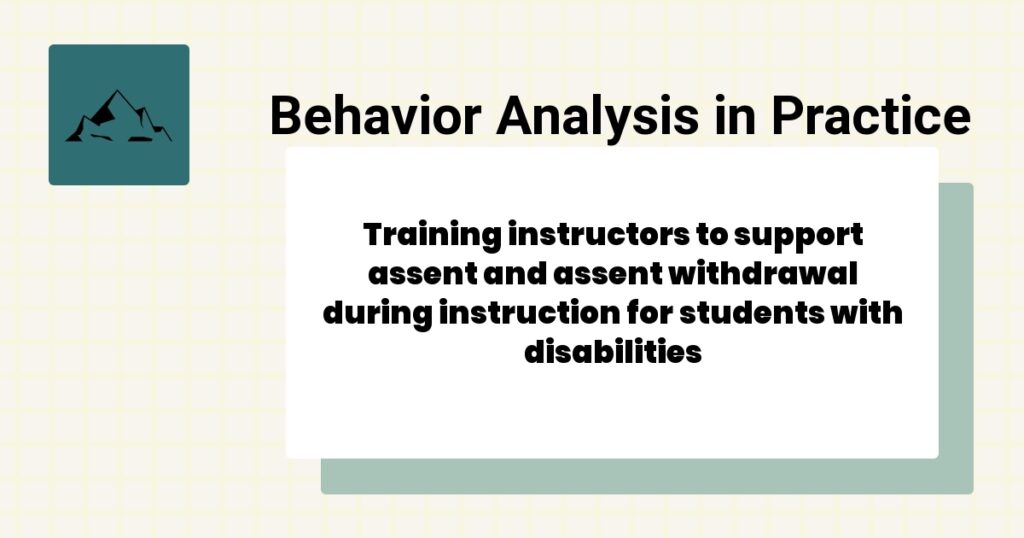
Weber, J., Weiss, M. J., & Ferris, K. (2025). Training instructors to support assent and assent withdrawal during instruction for students with disabilities. Behavior Analysis in Practice. https://doi.org/10.1007/s40617-025-01122-4