The Philosophical Assumptions Underlying Behavior Analysis: A Clinical Foundation
If you’ve been training in ABA or leading a clinic, you’ve likely heard phrases like “data-driven,” “simplest explanation first,” and “what works, we keep.” These aren’t just slogans—they reflect deeper beliefs about how behavior works and how we can reliably change it. These beliefs are called philosophical assumptions, and they form the foundation of everything behavior analysts do.
This post is for practicing BCBAs, clinic leaders, supervisors, and anyone training in ABA who wants to understand not just the how of behavior analysis, but the why. A solid grasp of these assumptions helps you make better clinical decisions, explain your approach to families and teams, and protect clients by grounding practice in evidence and ethics.
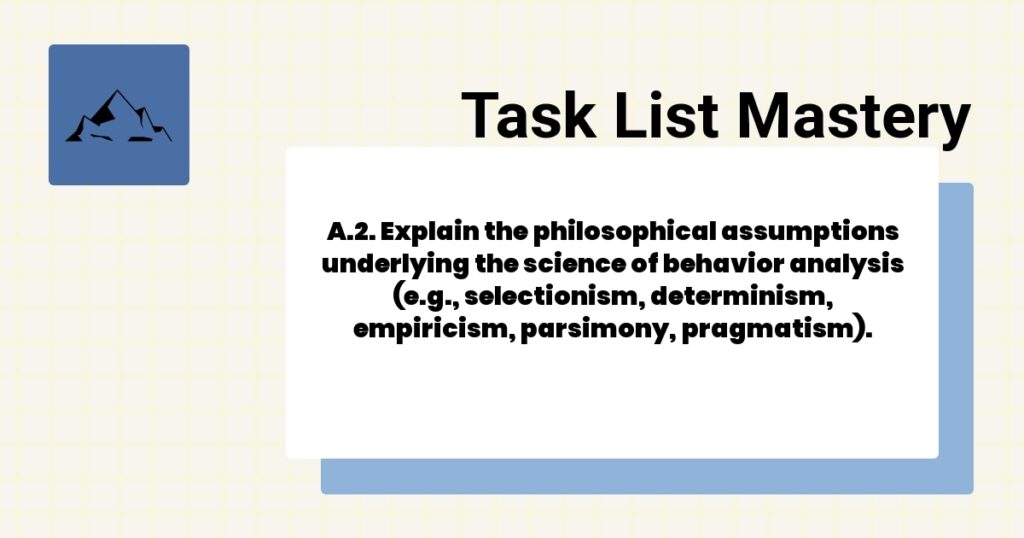
In this guide, we’ll define the five core philosophical assumptions, show how they work together, and map them to real clinical choices you make every day.
What Are Philosophical Assumptions?
Philosophical assumptions are foundational beliefs about how the world works—in this case, how behavior works and how we build reliable knowledge about it. They’re different from methods (like single-case design or functional analysis) and different from applied procedures (like reinforcement or prompting). Assumptions are the “why” that justifies the methods and procedures.
Your philosophical assumptions shape what questions you ask, what evidence you trust, and what interventions you’ll try. When you collect baseline data before starting a program, you’re acting on an assumption that objective measurement reveals truth. When you rule out a simple explanation before accepting a complex one, you’re living out an assumption about efficient thinking.
Understanding these assumptions also protects you from misapplying them. Believing in “simplicity” doesn’t mean ignoring important information. Believing in “what works” doesn’t mean skipping ethical review. We’ll clarify not just what the assumptions are, but where the boundaries lie.
The Five Core Philosophical Assumptions
Determinism: Behavior Has Causes
Determinism assumes that behavior doesn’t happen randomly. Every behavior has causes—events, conditions, or history that led to it. This assumption is foundational to the entire behavior-analytic enterprise.
When you assume determinism, you stop thinking, “Why does this child tantrum? Who knows—kids are unpredictable.” Instead, you think, “What variables are reliably present when tantrums happen? What consequences follow them?” You look for patterns. And because behavior has causes, changing those causes can change the behavior.
This assumption is often misunderstood as fatalism—the idea that outcomes are fixed and unchangeable. That’s the opposite of what determinism means in ABA. Determinism says behavior is determined by discoverable variables, which means those variables can be influenced. It’s actually the foundation for hope and intervention.
Empiricism: Measure and Observe
Empiricism means knowledge comes from objective observation and measurement, not hunches, intuition, or assumptions. If you want to know whether a child’s behavior is improving, you don’t ask yourself, “Does it feel better?” You count. You track. You graph.
Empiricism requires that your observations be public and repeatable. A colleague should be able to look at your data and reach similar conclusions. This is why behavior analysts use operational definitions and measurement—clear descriptions of what the behavior looks like so anyone can recognize it, and quantification so change is undeniable.
In practice, empiricism means you’re honest about what you don’t know. If your measurement is fuzzy or inconsistent, you admit that your conclusions are weaker. It also means you stay open to evidence that contradicts what you expected. Data guides your decisions, not the other way around.
Parsimony: Start Simple
Parsimony is the preference for simplicity. When multiple explanations fit the facts, choose the one that requires the fewest assumptions. In clinical work, this means ruling out straightforward causes before invoking complex theories.
Here’s a common example: a child’s aggression increases at a certain time of day. Before you design a complex social skills program, check—is the child hungry? Tired? Overstimulated? Are staff unintentionally reinforcing aggression with attention? Test the simple, observable explanations first.
Parsimony is misunderstood when clinicians use it to ignore complexity. The rule is not “always pick the simplest option.” The rule is “pick the simplest explanation that fits your data, and add complexity only when the simpler model fails.” If a complex explanation accounts for variability that a simple one doesn’t, use it. Parsimony is about efficiency, not oversimplification.
Pragmatism: Keep What Works
Pragmatism judges the value of an idea by whether it produces real, measurable results. If an intervention reliably improves behavior in the client’s actual life, it has value. If it doesn’t, discard it—regardless of how logical or elegant it seemed.
This assumption keeps ABA grounded in outcomes, not theory. You might have an elegant hypothesis about why a behavior occurs, but if your intervention based on that hypothesis doesn’t improve the behavior, you revise. Pragmatism also supports flexibility and individualization. What works for one child might not work for another, even if their behaviors look similar.
Pragmatism is sometimes dismissed as “anything goes.” That’s a misreading. In ABA, pragmatism is tethered to measurement and ethics. You measure the outcomes, you adjust based on data, and you do all of this within informed consent and ethical bounds. Unmeasured interventions and untested techniques don’t count as pragmatic; they’re just guessing.
Selectionism: Behavior Shaped Over Time
Selectionism explains behavior as shaped and maintained by its consequences over time. If a behavior reliably produces a reinforcer, that consequence selects and strengthens the behavior. This happens at the individual level (a child learns that raising her hand gets attention) and at broader cultural levels (practices that solve problems tend to persist in organizations and communities).
Understanding selectionism means you always ask, “What consequences are currently maintaining this behavior?” A tantrum that produces a toy, escape from a task, or adult attention is being reinforced. A skill that’s practiced because it produces social approval or success is being selected. When you design an intervention, you’re usually manipulating consequences—strengthening desirable behaviors through reinforcement, weakening undesirable ones by removing the reinforcer.
Selectionism also reminds you that current behavior makes sense in light of its history. A child who has learned that screaming gets her needs met isn’t being stubborn; her behavior was selected by past consequences. This reframe often reduces blame and increases empathy.
How These Assumptions Work Together
These five assumptions are complementary, not isolated. When you conduct a functional analysis, you’re using all of them at once.
Determinism tells you there are causes to find. Empiricism dictates that you measure behavior and environmental events carefully to reveal those causes. Parsimony guides you to test straightforward functional relations before considering complex diagnoses. Selectionism reminds you to look at consequences as the primary drivers of behavior. And pragmatism keeps you focused on whether your analysis actually leads to an intervention that improves the client’s life.
No single assumption is enough. Empiricism without selectionism might lead you to collect lots of data without understanding the behavior’s function. Pragmatism without empiricism might lead you to use interventions that feel helpful but lack evidence. Together, the five assumptions create a coherent worldview that guides rigorous, ethical, effective practice.
Why This Matters in Your Daily Clinical Work
These assumptions justify ABA’s reliance on measurement, replication, and experimental control. If you assume behavior is lawful and can only be known through objective measurement, then collecting baseline data, graphing trends, and showing that behavior changed after your intervention is not optional—it’s how you prove you’re doing behavior analysis.
Your assumptions also guide which interventions you consider first. Parsimony suggests starting with environmental changes and reinforcement strategies before adding medication or complex classroom restructuring. Selectionism suggests that reinforcement might work better than punishment, because it directly shapes the behavior you want. Pragmatism means you monitor the data closely and adjust if progress stalls, rather than stubbornly sticking to a plan that isn’t working.
Perhaps most importantly, these assumptions support ethical practice. Empiricism means you document your decisions transparently—others can see your data and review your logic. Parsimony and pragmatism together support the least restrictive alternative: use the simplest, least intrusive intervention that produces measurable results. Determinism means you’re always looking for variables you can change, rather than blaming the client.
Distinguishing Assumptions from Methods and Applied Procedures
It’s easy to confuse these layers, so let’s clarify. Philosophical assumptions are beliefs (e.g., “behavior is lawful,” “measurement reveals truth”). Methods are the tools you use to apply those assumptions (e.g., single-case experimental design, functional analysis, operational definitions). Applied procedures are the interventions themselves (e.g., differential reinforcement, token systems, extinction).
A single-case design is a method that expresses empiricism and determinism in practice. Operational definitions support empiricism. Functional analysis is grounded in determinism, empiricism, and selectionism.
When training staff or supervisees, make this distinction clear. You’re not teaching a method because it’s trendy. You’re teaching it because it’s rooted in solid assumptions about how behavior works and how knowledge is built.
Common Pitfalls and How to Avoid Them
Confusing determinism with fatalism. Some clinicians misunderstand determinism as “outcomes are fixed.” The opposite is true—if behavior has causes and those causes are discoverable, intervention is possible. Determinism is liberation, not defeat.
Using parsimony as an excuse to oversimplify. “It’s just seeking attention” can feel satisfyingly simple. But if that explanation doesn’t account for when the behavior happens and when it doesn’t, it’s not parsimonious—it’s incomplete. Parsimony requires that your simple explanation fit all the relevant data.
Calling any useful technique “pragmatic.” A procedure that seems to help but hasn’t been measured isn’t pragmatic; it’s untested. Pragmatism requires ongoing measurement and willingness to abandon approaches that don’t produce results.
Ignoring the client’s history. You can’t understand current behavior without understanding what consequences have shaped it. A child’s skill deficits might reflect a lack of opportunity to learn, not a lack of ability.

Treating empiricism as “numbers only.” Qualitative observation still counts as empiricism if it’s systematic, public, and repeatable. That said, quantification is usually more reliable than subjective impression.
Practical Application: From Assumptions to Clinical Action
Here’s how these assumptions guide a real clinical decision: A child’s compliance improves during one teacher’s class but not another’s.
Using determinism, you assume there are variables that explain the difference—not magic, not the child’s mood. Using empiricism, you define noncompliance precisely and measure it in both settings. Using parsimony, you start with straightforward hypotheses: Does one teacher provide clearer instructions? Different consequences? Using selectionism, you hypothesize that one teacher’s approach is reinforcing compliance while the other’s isn’t. Using pragmatism, you implement the effective teacher’s approach in the second class and measure whether compliance improves—if yes, keep it; if no, adjust.
That entire process flows from the assumptions. Without them, you might assume the child has a “compliance problem” independent of setting and spend months on complex social-emotional work that misses the point entirely.
Ethical Grounding: Why Assumptions Matter Beyond the Clinic
Your philosophical assumptions protect clients. When you assume behavior is determined by discoverable variables, you stay curious and avoid labeling or blaming. When you require empiricism, you hold yourself accountable—you can’t claim success without data. When you apply parsimony ethically, you choose the least restrictive intervention first, meeting your duty to do no harm. When you balance pragmatism with ethics, you keep interventions flexible while respecting informed consent and individual dignity.
These assumptions also support cultural humility. Selectionism reminds you that behavior patterns make sense within the person’s history and social context. A practice that works for one family might not fit another’s values or constraints. Empiricism demands you measure what matters to that client and family, not just what’s easy to count.
Building Competence: Teaching These Ideas to Your Team
When training supervisees or staff, introduce one assumption at a time with a concrete case. Start with a simple scenario—a child’s behavior, a staff interaction, a systems issue—and ask, “What does empiricism tell us to do? What does parsimony suggest?” Role-play measurement and functional analysis. The ideas become clear when people see them in action, not when someone lectures about philosophy.
Use examples from your own clinic or community, not generic textbook cases. Real clinicians learn by connecting abstract ideas to the decisions they make every week.
Key Takeaways
The five philosophical assumptions—determinism, empiricism, parsimony, pragmatism, and selectionism—are not abstract theory. They’re the backbone of how you decide what to measure, which intervention to try first, and how you know if you’re actually helping.
Empiricism and measurement come first, because objectivity reveals patterns gut feelings can miss. Look for causes (determinism), prefer simple explanations that fit your data (parsimony), consider what consequences are shaping behavior (selectionism), and adjust based on real results (pragmatism).
When you apply these assumptions honestly and ethically, you protect clients, earn trust from families and teams, and build an evidence-based practice that actually works. Start simple, measure carefully, stay curious about causes, and keep what works. That sequence—grounded in philosophy—is how behavior analysis becomes a science that truly helps.