Understanding and Reducing Ableism in ABA Practice
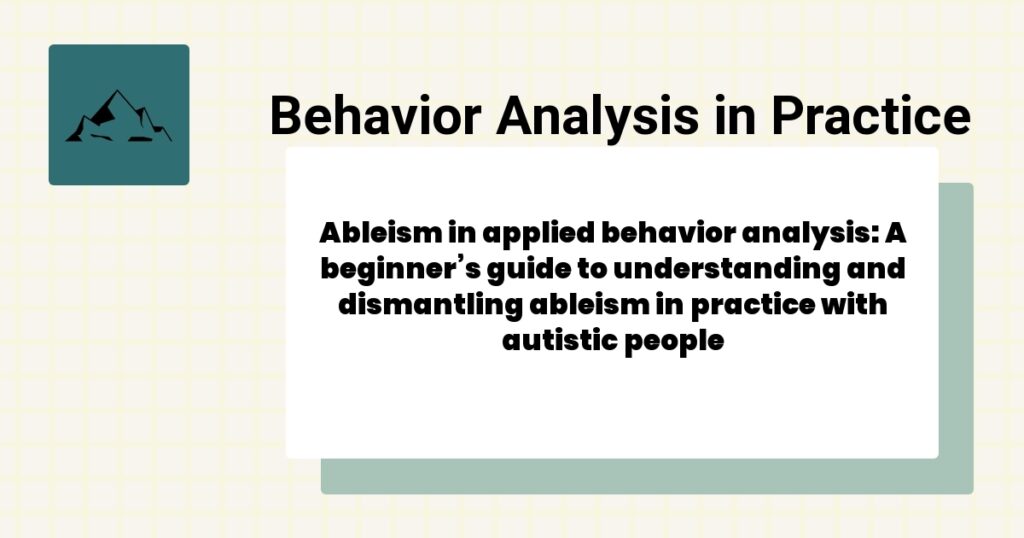
Ableism—treating disabled people as “less than,” even unintentionally—can quietly shape the goals we set, the methods we choose, and the language we use in ABA services. This paper offers behavior analysts a practical starting point for recognizing where bias might hide in everyday clinical decisions. The guidance matters now, even as stronger research continues to develop, because our ethical obligation to avoid harm doesn’t wait.
What is the research question being asked and why does it matter?
This paper asks a practical question: How does ableism show up in ABA services for Autistic people, and what should behavior analysts do to reduce it?
Ableism is when our thoughts, words, or actions treat disabled people as “less than,” even unintentionally. In ABA, this can lead to goals and teaching methods that prioritize looking “normal” over a person’s comfort, choice, and quality of life. That erodes trust, makes services feel unsafe, and can trigger stress behaviors like shutting down, masking, or meltdowns.
This matters because BCBAs and RBTs make many small decisions every day that shape a client’s life. If hidden bias guides those decisions, we can accidentally push learners to tolerate too much, lose control over their own bodies, or have their needs ignored.
The paper also raises a key tension: there isn’t much strong research yet on “anti-ableist” ABA practices, but our ethics code already requires us to avoid harm and discrimination. Clinicians need to start improving practice now, while better research catches up.
What did the researchers do to answer that question?
This is a discussion and review paper, not an experiment. The authors defined ableism, explained different kinds of bias—systemic, explicit, and implicit—and described how ableism can appear in ABA work. They focused mainly on implicit bias: when a practitioner doesn’t notice their own assumptions, but those assumptions still affect decisions.
The authors used examples from common ABA settings and connected them to existing writing across ABA, disability studies, and Autistic perspectives. They highlighted practice areas where ableism can hide: choosing goals, deciding what counts as “problem behavior,” measuring outcomes, and writing reports. They also offered practical changes, such as building assent into sessions, checking social validity from the client’s point of view, and avoiding language that dehumanizes or infantilizes.
Because no new data were collected, these action steps are best understood as practice guidance—not proven treatment packages. Treat this paper like an ethics-and-quality checklist to improve services, not like a research study that tells you what will work for every client.
How you can use this in your day-to-day clinical practice
Start by assuming you, like all humans, have learned bias from your culture and the systems around you. That means planning for “bias checks,” not just data checks.
Before finalizing goals, ask yourself: Am I targeting this because it’s unsafe or blocks the person’s life, or because it looks unusual? If the main reason is “it looks odd,” pause and gather more input from the learner and family before moving forward.
Separating “harmful” from “different”
When choosing targets, distinguish behaviors that cause harm from behaviors that are simply different. Aggression that can injure someone usually needs a support plan—safety matters. But hand flapping, rocking, or talking to oneself may help with calming, focus, or communication.
If a behavior isn’t dangerous, don’t automatically program it for reduction. Consider whether the environment needs to change, whether the person needs a break or sensory support, or whether you should teach context skills only when the learner wants that help.
Building assent into sessions
Build assent into your daily session flow, even for learners with limited speech. Assent isn’t only a verbal “yes.” It can look like approaching materials, relaxed body, staying engaged, or choosing to continue. Withdrawal can look like pushing materials away, leaving, crying, freezing, or refusing.
When you see withdrawal, treat it as information—not “noncompliance.” Your job is to adjust the plan first, unless there’s a clear and serious safety reason not to.
Plan ahead for what you’ll do when assent drops so staff don’t panic and add pressure. You might rotate tasks, change the order, offer a different response mode, shorten the demand, or move to a break with a clear return plan.
If a learner regularly withdraws assent during a program, take that as a signal. The program may not be socially valid, or it may be too hard, too long, or too uncomfortable. Don’t solve this only by increasing reinforcement or adding escape extinction without a careful review of harm risk, dignity, and long-term trust.
Improving social validity
Get the learner’s viewpoint in a real way—not just by asking adults what they want. If the client can answer questions, ask what they want to learn and how they want help. If they can’t, use choice-making, preference assessments, and observation to learn what they approach and avoid.
Check whether the learner prefers certain teaching styles, prompts, materials, or locations. Measure not only skill data but also indicators that the learner’s life is improving: more access to preferred activities, more independence, fewer crisis situations, and more ability to say “no” safely.
Watching for double standards
Notice where neurotypical people get flexibility but Autistic people are told to tolerate. Many people avoid eye contact when stressed, but Autistic people are often trained to force it.
If you work on social goals, focus on functional communication and mutual comfort—not performing a “normal” body style. Teach skills like asking for clarification, requesting space, and setting boundaries. Those protect the learner in real life.
Changing language and framing
Change how you write and talk about clients so your language doesn’t quietly teach others to see them as broken. Avoid labels like “low functioning,” “maladaptive,” or “antisocial” when you can describe what’s actually happening.
Include strengths, interests, and best learning conditions in plans—not just deficits. Write goals that show the client has agency, such as increasing self-advocacy, choice-making, and communication that reduces the need for crisis behaviors.

Being careful with restriction
Be careful with restrictive procedures and settings. Don’t assume a more restrictive placement is needed just because behavior is hard.
If restraint is ever part of your environment, treat it as crisis-only. Define what “crisis” means ahead of time, and end restraint as soon as imminent danger ends. Plan fading steps from day one, and review each use to prevent “restraint until calm” from becoming control instead of safety.
Collaborating with caregivers
Use caregiver collaboration to protect the learner’s voice, not replace it. Caregivers matter, but they aren’t the same as the client.
When caregiver goals conflict with the learner’s preferences, try to understand why. Often the learner is communicating sensory needs, comfort needs, or identity needs. Your role is to help negotiate goals that matter to the learner and are also useful for daily life—without turning the plan into “training the child to please adults.”
Treating this as a starting point
Treat this paper’s ideas as a starting point, not a final answer. It’s not based on new outcome data, and it won’t fit every learner or situation.
Use it to guide reflective supervision, team discussions, and day-to-day decision rules—while still relying on data, ethics, client preferences, and your clinical judgment. The most important change is making “dignity, choice, and meaningful outcomes” part of the plan the same way you make measurement and treatment integrity part of the plan.
Works Cited
McComas, J. J., Wilczynski, S., Cerda, M.-L., Beavis, H. S., Drossel, C., Sundberg, S., & Anderson Jr., K. D. (2025). Ableism in applied behavior analysis: A beginner’s guide to understanding and dismantling ableism in practice with autistic people. Behavior Analysis in Practice. https://doi.org/10.1007/s40617-025-01128-y